Fifth Edition of “48 Hours Varusha South” Brings 123 Events to Veliko Tarnovo
August 6, 2026 - Events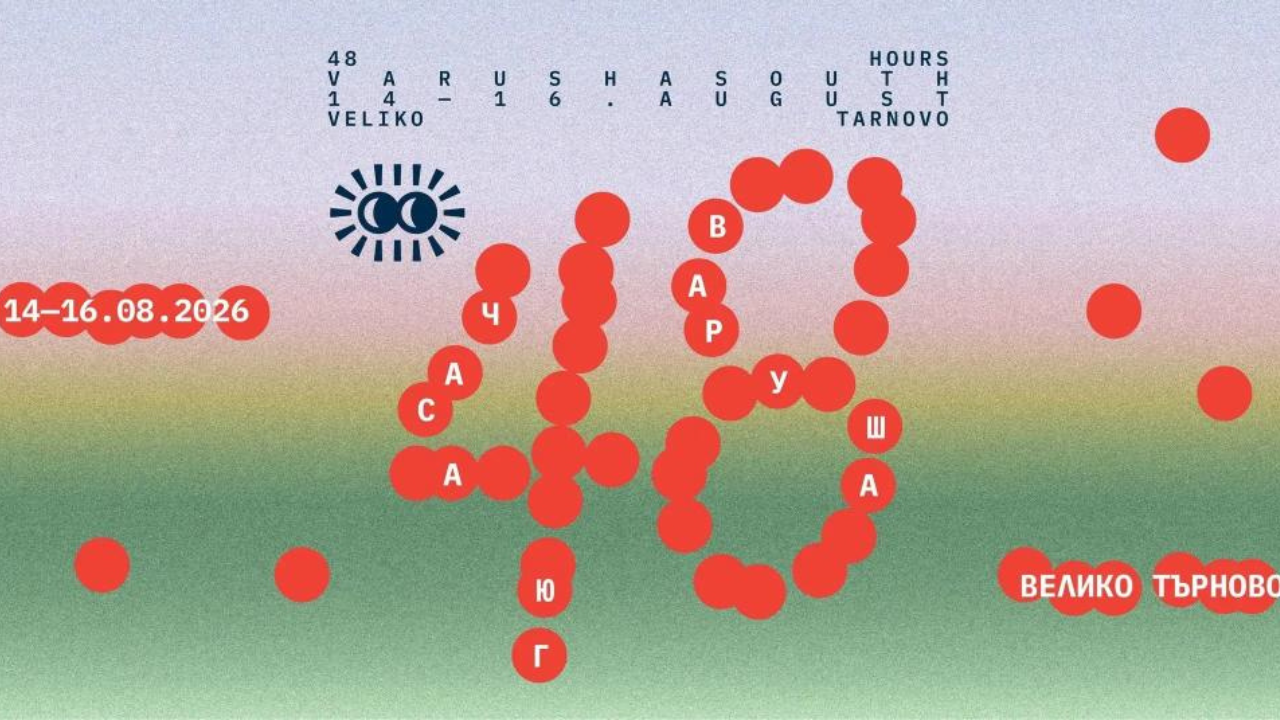
The fifth edition of the “48 Hours Varusha South” festival will take place from 14 to 16 August 2026 in the Varusha South neighbourhood as part of the Cultural Calendar of Veliko Tarnovo Municipality.
Over the course of 48 hours, residents and visitors will be able to attend 123 events, including exhibitions, concerts, artistic interventions, workshops, discussions, literary gatherings and other initiatives inviting audiences to explore — or rediscover — Veliko Tarnovo’s Old Town.
This year’s programme is once again divided into six thematic categories: Visual Arts, Creativity and Relaxation, Architecture, Music, Family Programme, and, for the first time, Literature and Science.
Each new edition of the festival opens new spaces, attracts new artists, creates new partnerships and brings together the stories of an increasing number of people. After five years of organic growth, this year’s theme — “Enough is better than more” — turns the focus inward, towards the values and established partnerships that have driven community processes in the neighbourhood.
“The world around us constantly encourages us to look for more — more experiences, more content, more space, more speed. This year’s festival asks a different question: What happens when we stop for a moment? When, instead of adding more, we begin to notice what is already there? The most valuable things are not always those we seek in our desire for ‘more’. Often, what is ‘enough’ is already around us. We simply need to pay attention to it,” says Ilina Peneva from the festival’s organising team.
One of the festival’s emblematic locations is Yantra Beach. This spring, natural processes and the rising waters of the Yantra River transformed the familiar landscape, sweeping away the yoga house on the beach as well as some of the trees that had provided a natural backdrop to festival gatherings in recent years.
The location will not look the same as visitors remember it from the previous four editions. Yet it is precisely here that one of the most important elements of “48 Hours Varusha South” becomes visible — the community. Volunteer initiatives aimed at restoring the riverside area are already taking place alongside preparations for the festival.
“Sometimes choosing ‘enough’ means taking care of the resources, places and relationships that have already been created,” says Galin Popov from the festival team.
“It is precisely by relying on partnerships between existing cultural initiatives and institutions in the city that we were able to organise a performance by internationally recognised German musician Sebastian Studnitzky, with the support of the Goethe-Institut. For the first time, the community project ‘48 Hours Varusha South’, the Konstantin Kisimov Music and Drama Theatre and the established ‘Stage of the Ages’ festival are jointly inviting residents and visitors to Veliko Tarnovo on an elegant journey through jazz, classical and electronic music.”
The musical performance “MEMENTO” will bring together world-renowned musicians Sebastian Studnitzky on trumpet and piano, Igor Spallati on bass and Mathis Grossmann on drums, together with the orchestra of the Konstantin Kisimov Music and Drama Theatre, conducted by Maestro Gancho Ganchev.
Due to the scale of the production and its inclusion in the “Stage of the Ages” programme, the event will require a ticket. Organisers, however, have aimed to keep ticket prices as accessible as possible. Tickets are available online through the theatre’s website and at its box office, as well as at several cultural and commercial venues around Veliko Tarnovo.
Another highlight of the music programme is an audio-visual performance by DJ KiNK, who will collaborate with 3D mapping studio Elektrick.Me to transform the Lapidarium of the Archaeological Museum on Friday evening, with the support of the Regional History Museum – Veliko Tarnovo.
As festival tradition has established, on Saturday Stefan Stambolov Street will become a pedestrian zone. At the familiar Piccolo, Stambolov and Hipster stages, visitors will enjoy performances by local and international artists.
Among the performers are the Nilza Costa Quartet from Brazil, Kan Wakan, Tri O’ Five, local band Svezhi Taralezhi, and DJs Nikolay Kolev and Nikolay Bozhinov.
Festival visitors will also have the opportunity to take part in a karaoke stage hosted by Silver Court. Sunday’s programme will conclude with a concert by the international jazz musicians of Blazin’ Quartet at Yantra Beach.
During Saturday’s programme, the Samovodska Charshiya historic street will be transformed into a 70-metre-long communal table, where everyone will be welcome to bring homemade food or something purchased from nearby local establishments.
The initiative is a partnership between Mastercard and IKEA and turns the idea of community into a tangible experience, allowing strangers to sit next to each other, share a moment from the festival and take part in IKEA’s workshops and crafts area.
Samovodska Charshiya is one of the neighbourhood’s most recognisable locations, but visitors looking for the programme’s other 50 venues will once again be able to navigate the Old Town with the help of an interactive map in a web GIS application created by Esri Bulgaria.
An electronic festival programme is also available on 48.varushasouth.art, a website created by Veliko Tarnovo-based web design company NovaLink. For visitors who prefer traditional information sources, a printed programme will be available at the festival information point at 14 Velcho Dzhamdzhiyata Street, produced with the support of Extrapack.
The Architect’s House will return to its original role as a meeting point for architecture, art and design, hosting exhibitions dedicated to the architectural heritage of abandoned settlements and to the history of Varusha’s bricks, past and present.
The Nadezhda Community Centre will once again host an architectural forum. This year’s programme will feature lectures on reconstruction projects in the neighbourhood, a graduate project dedicated to the Mavrikov factory and the story of an unusual “Japanese” figure who returned to Bulgaria to build his dream home at the foot of the Balkan Mountains.
At the Architects’ Club, Sharena Fabrika, a new culinary school based in the picturesque village of Golyama Zhelyazna near Troyan, will present a three-day programme of workshops dedicated to working with dough.
Another highlight of the Creativity and Relaxation programme is the Kashtata Centre for Applied Arts and Crafts, which will remain open throughout Saturday and Sunday, offering visitors opportunities to experience traditional crafts including weaving, artistic ceramics, pottery, coppersmithing and calligraphy.
The creative space Tarsach will invite festival guests to explore a museum of music formats and recording media, create a collective story about Varusha South or discover how a song is recorded.
The organisation CVS-Bulgaria will support the creative energy of young people and the festival’s dozens of volunteers, while also organising youth events in front of the Petko R. Slaveykov Regional Library.
The Visual Arts programme highlights Varusha’s rich artistic scene, bringing together local artists with visiting creators, curators and galleries from across Bulgaria.
For the first time, festival visitors will have the opportunity to enter the studios of four Veliko Tarnovo artists — Krasimir Rusev, Valentina Lapcheva, Tsvetelina Maksimova and Militsa Mineva.
In the new and still unfinished wing of Hadji Nikoli Inn, Gancho Ganchev will present the exhibition “Last Drop”, transforming the raw space into an improvised gallery. Meanwhile, his own gallery, Narrativa, will host an exhibition by Konstantin Konstantinov.
Other highlights include an exhibition by the e-valuation platform at TaM, presenting works by Marina Genova, Mihaela Lakova, Rayna Teneva and Aaron Roth, curated by Galina Dimitrova.
The programme also includes “Feathered States”, an exhibition by Nora Ampova and Lyuben Domozetski organised by Little Bird Place Gallery at ARTE Hotel, as well as “Direction STRONG” by the EMPROVE Foundation.
The Varna-based visual arts forum BUNA will participate with “Symbiotic Synchronicity”, an interactive installation by Austrian artist Dagmar Schürrer, curated by Irina Batkova and presented at Heerz Tooya Gallery.
At DRAKA, visitors will be able to see Veneta Androva’s exhibition “Stretch & Release”, presented within the “1m² Art” format created by Veliko Tarnovo curator Martina Yordanova, who represented Bulgaria at the 61st Venice Biennale.
Students will once again play an active role in the programme, including the photographic series “Take Your Place” by the art duo Lobotomy and Preslava Damyanova’s continuing visual exploration of the Veliko Tarnovo landscape, “More SOUNDGRAMS”.
A poster exhibition from the competition organised by PromeniKartinkata, in cooperation with the International Triennial of Stage Poster, will draw attention to environmental pollution caused by improperly discarded cigarette butts and to the risk of fires caused by cigarettes that have not been fully extinguished.
The awareness campaign by Philip Morris Bulgaria, encouraging responsible consumer behaviour, will be complemented by screenings of short films created by students from the National Academy for Theatre and Film Arts.
For the first time, this year’s festival also features a dedicated Literature and Science programme.
One of its main highlights will be a presentation by Dr Zornitsa Draganova from the Institute of Philosophy and Sociology at the Bulgarian Academy of Sciences, entitled “The Traces of the Festival: Culture, People and the Urban Environment.”
The research examines what has actually changed in the neighbourhood over the past five years and how people experience it — a question that this year’s festival directs not only towards the city, but also towards itself.
What has remained consistent is the festival’s cooperation with institutional, international and local partners, whose support has made each successive edition possible.
Among this year’s examples of successful partnerships is Hygienic-Medical Industry AD, which will install disinfection stations throughout the neighbourhood.
Hitachi Energy is joining the festival as a partner for the first time and will invite younger visitors to experience the magic of the Japanese art of Ebru, a traditional technique of painting on water.
The Boris Denev Art Gallery will once again host a range of events, including literary meetings, critical interpretations of contemporary art, puppet theatre and philosophy breakfasts for children.
The festival team emphasises that organising an urban event of this scale would not be possible without the support of many additional partners.
Veliko Tarnovo-based company Aglika, for example, is producing a limited series of deckchairs featuring the festival’s new visual identity, once again created by designers Izabela Markova and Todor Georgiev.
Hotels Honey, I’m Home and Bridges Residence will provide accommodation for international and Bulgarian participants, while Shtastlivetsa Restaurant and the Strazhitsa bakery will provide food for participants and volunteers.
Devin will supply mineral water for volunteers and artists.
For another year, the Bulgarian News Agency (BTA) and the information portal “For the Children of Veliko Tarnovo” will provide media support, while Dynaphos will once again invite festival visitors to take part in a photography competition.
Business Centre Veliko Tarnovo (BCVT) is also providing financial support, with its team backing initiatives that contribute to the development of the city.
The event is funded through the Culture Programme of Veliko Tarnovo Municipality.
All of these partnerships take different forms, but they share one common purpose: making possible an urban event that does not exist only for 48 hours, but continues throughout the year to build connections between the people, places and stories of Veliko Tarnovo.
Five years ago, “48 Hours Varusha South” began as an invitation to look at the identity of a neighbourhood in a new and constructive way.
Today, the festival has already become part of that neighbourhood’s history.
It brings together dozens of independent artists, cultural organisations, local initiatives, and Bulgarian and international partners who do more than simply participate in the programme. They share the belief that culture is built through long-term relationships and mutual trust.
It is thanks to this community that Varusha continues to be a place where art does not happen separately from everyday life, but becomes part of it.
Because sometimes, the feeling that we already have enough is precisely what allows us to truly see the place we are in.